Brain Health Resilience | Information Architecture & Website Redesign | 2026
University of North Carolina Wilmington (UNCW)
Role: Information Architecture · UX Design · Content Strategy · Project Management · Website Implementation
Focus Areas: Information Architecture · Interaction Design · Project & Program Management
Overview
Led the end-to-end redesign of UNCW's Brain Health & Resilience (BHR) website, transforming a content-heavy landing page into a structured, multi-page research website.
Developed a new information architecture and content hierarchy, wireframed and implemented the expanded site, and coordinated the production of six videos to support BHR's growing research and digital content needs.
Challenge
The original website consolidated information about BHR's mission, team, research, opportunities, and news into a single landing page.
Four distinct research areas shared space within the same page rather than having dedicated destinations.
Different types of content competed within a single hierarchy, limiting opportunities for deeper exploration.
Continued growth required a more scalable structure capable of supporting additional research, resources, and multimedia content.
The existing experience needed to evolve from a single informational page into a navigable website.
Original Experience
The original BHR experience housed the initiative's primary content within one continuous landing page, requiring users to scroll through multiple unrelated content areas to locate specific information.
Process
Phase 1: Content Evaluation & Information Architecture
Evaluated the existing content to identify distinct content types, relationships, and opportunities for restructuring.
Developed a new site hierarchy organized around four primary content areas:
About
Established a dedicated space for BHR's mission and organizational information, with a supporting Meet the Team page.
Research
Created a central overview of BHR's research portfolio with dedicated pages for Translational Brain Health, Neuroplasticity, Head & Neck Trauma, and Substance Use & Data Science.
Opportunities
Separated engagement opportunities into a dedicated destination rather than embedding them among unrelated content.
News
Created a clear pathway to BHR news and research coverage within UNCW's broader news ecosystem.
The resulting architecture supports both high-level exploration and deeper navigation while providing room for the site to grow over time.
Information Architecture Transformation
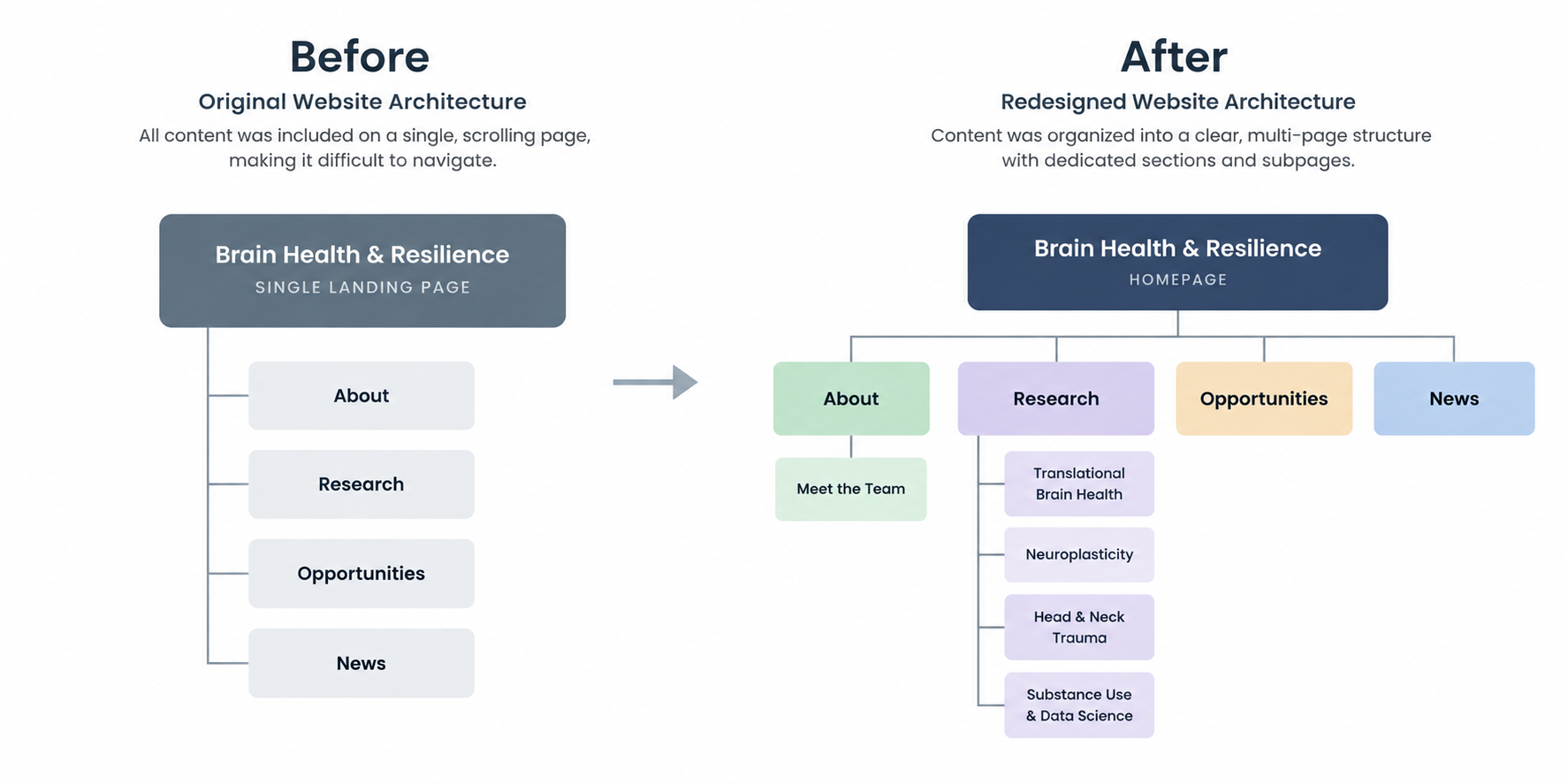
Before: A single landing page containing BHR's organizational, research, team, opportunity, and news content.
After: A multi-level website with four primary content areas, dedicated supporting pages, and clear relationships between parent and child content.
Phase 2: Wireframing & Page Design
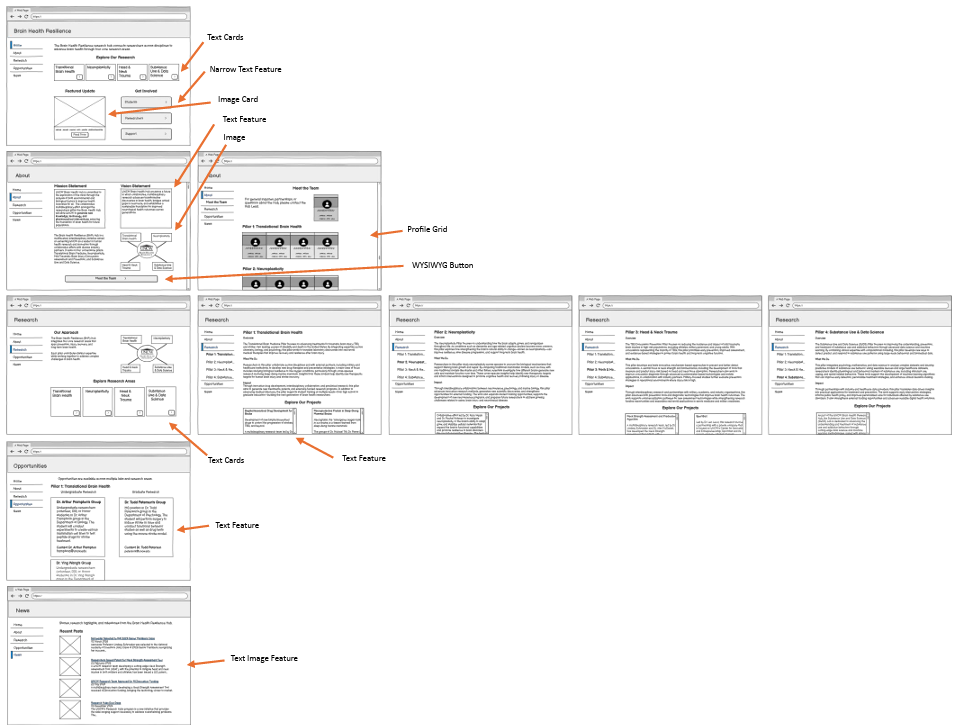
Translated the new information architecture into individual page structures and navigation pathways.
Repositioned the homepage as an entry point into the broader BHR site rather than the destination for all content.
Developed section landing pages to introduce major topics and direct users toward more detailed information.
Created dedicated page structures for content requiring greater depth, including individual research areas.
Established consistent hierarchy and organization across related pages.
Wireframes
Phase 3: Website Implementation & Content Coordination
Built and implemented the expanded site within UNCW's existing web environment.
Applied the new navigation hierarchy across the website while maintaining consistency with university web standards.
Organized and adapted existing content for the new page structure.
Identified opportunities to expand BHR's digital storytelling beyond written content.
Initiated and coordinated the production of six videos with UNCW's video team for future integration throughout the site.
Working within an established institutional design system placed greater emphasis on information hierarchy, navigation, content organization, and usability rather than visual reinvention.
Solution
A Scalable Website Architecture
Transformed the original landing page into a multi-page website with clear pathways into BHR's primary content areas:
Home
Introduces BHR and provides entry points into the broader site.
About
Provides organizational context with a dedicated Meet the Team page.
Research
Introduces BHR's research portfolio and connects users to dedicated pages for each of its four research areas.
Opportunities
Provides a standalone destination for engagement and participation opportunities.
News
Connects users with BHR news and research coverage within UNCW's existing news ecosystem.
The new architecture gives distinct content an appropriate place within the larger system while maintaining clear relationships between related information.
Final Experience
Multimedia Integration
Expanded the website initiative beyond structural redesign through the development of six new video assets.
Identified opportunities for multimedia storytelling within the expanded site.
Initiated and coordinated video production with UNCW's video team.
Planned video placement within the new information architecture to complement existing written content.
Created additional opportunities for BHR to communicate complex research in more accessible and engaging formats.
Impact
Expanded BHR's digital presence from a single landing page into a structured, multi-page website.
Established a clear hierarchy across organizational, research, opportunity, and news content.
Created dedicated destinations for each of BHR's four research areas.
Provided greater space for individual research areas to communicate their work and accommodate future content.
Established a scalable architecture capable of supporting continued research, news, opportunities, and multimedia growth.
Delivered the new information architecture as a fully implemented, live website.
Extended the initiative through the coordination and production of six additional video assets.
The project shifted BHR's digital presence from a page containing information about the initiative to a structured website capable of growing alongside it.
Learnings
Effective information architecture requires understanding both existing content and the relationships that will need to support future growth.
Moving content onto separate pages is most effective when those pages form a coherent system rather than simply reducing the length of a page.
Wireframing provides an important bridge between abstract site architecture and the experience of navigating individual pages.
Working within an established design system can place greater emphasis on structural UX decisions—including hierarchy, navigation, and content organization.
Website initiatives often extend beyond the interface itself, requiring content strategy, cross-functional coordination, and project management to create a cohesive digital experience.
Tools & Methods
Information Architecture · Content Auditing · Sitemap Development · Wireframing · UX Design · Content Strategy · Website Implementation · Project Management · Cross-Functional Coordination