Enterprise Communication Hub | Communication System & Interaction Design | 2024
Role: UX Design · Information Architecture · Interaction Design · Systems Design
Focus Areas: Information Architecture · Interaction Design
Overview
Designed a centralized internal communication system to support organizational messaging, channel management, and role-based collaboration.
Developed the system's information architecture, communication workflows, permission structures, and interaction patterns. Created a flexible experience combining quick-access messaging with a comprehensive communication hub to accommodate different user needs and workflows.
Challenge
The organization needed a centralized system to support internal communication across users and teams.
Different user roles required varying levels of access, administrative control, and messaging permissions.
Channels, conversations, and archived messages needed a clear organizational structure.
Users needed efficient access to ongoing conversations without disrupting other workflows.
The system needed to support both quick interactions and more detailed communication management.
The primary challenge was designing a communication experience that balanced system complexity, user permissions, and everyday usability.
Process
Phase 1: Communication Architecture & Core System Design
Established the foundational structure of the communication system by evaluating user needs, communication patterns, and organizational requirements.
Analyzed communication workflows to identify essential messaging capabilities.
Defined a hierarchical channel structure to organize conversations and support different communication contexts.
Mapped role-based permissions and administrative capabilities.
Developed interaction patterns for messaging, threaded conversations, and channel management.
Established notification behaviors and unread-message indicators.
Considered message archiving and search requirements within the broader system architecture.
This phase focused on organizing the underlying system before refining how users would interact with it.
Core System Wireframes
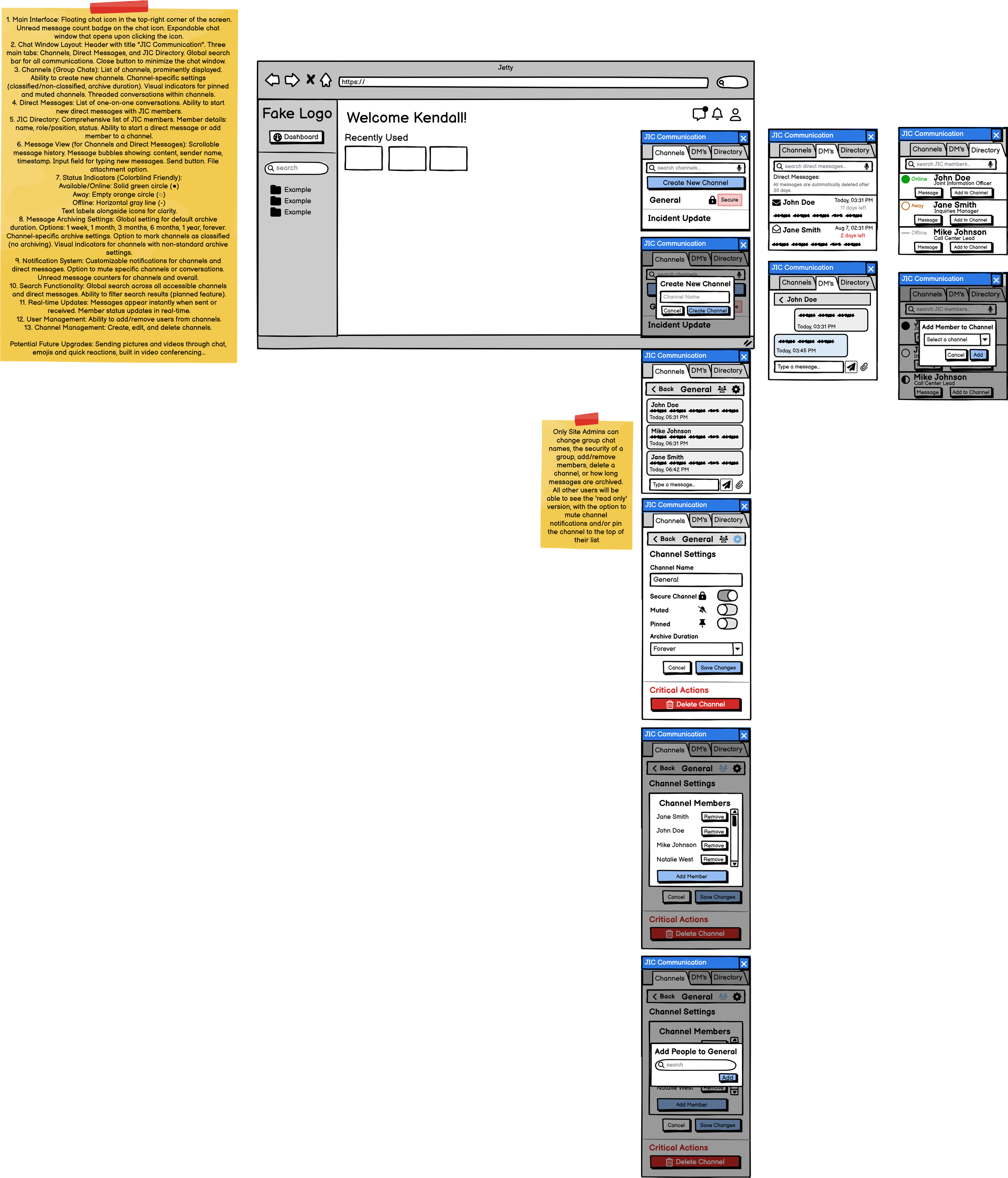
Initial wireframes (pictured top right) explored the foundational messaging interface, channel organization, administrative controls, and communication workflows.
Phase 2: Navigation & Interaction Design
Expanded the initial system design to support different levels of engagement and improve access to communication features.
Developed a dual-navigation approach combining a floating chat interface with a full-page communication hub.
Designed quick-access interactions for viewing messages and navigating conversations.
Expanded the full-page experience to accommodate more detailed communication and channel management.
Incorporated user avatars to strengthen visual identification within conversations.
Organized user lists alphabetically to support navigation and identification.
Refined messaging layouts, conversation threading, and interface states.
The resulting approach provided two complementary ways to access the same communication system without requiring users to navigate through a single interface for every task.
Interaction Design Iterations
Solution
A Centralized Communication System
Designed an integrated messaging experience that brings conversations, channels, notifications, and message management into a unified system.
The proposed solution includes several interconnected capabilities.
Flexible Access & Navigation
Floating Chat Interface
Provides quick access to conversations and unread-message indicators without requiring users to leave their current workflow.
Full-Page Communication Hub
Offers an expanded environment for navigating channels, managing conversations, and accessing additional messaging features.
User Identification
Incorporates avatars and alphabetically organized user lists to support recognition and navigation.
Channel & Message Organization
Hierarchical channel organization to establish relationships between communication spaces.
Pinned, private, and muted channel states to support different user preferences and access requirements.
Threaded conversations to maintain context within ongoing discussions.
Real-time messaging updates and notification indicators.
Message archiving and global search capabilities to support information retrieval.
Role-Based Permissions & Administration
Designed a permission structure that accommodates different responsibilities within the organization.
Role-based access to communication features and channels.
Administrative controls for managing users and system settings.
User-specific preferences and configuration options.
Distinct administrative and standard-user interactions.
These capabilities were organized as part of the broader communication architecture rather than treated as isolated interface features.
Impact
Developed a centralized communication system design addressing organizational messaging and collaboration requirements.
Established a hierarchical information architecture for channels, conversations, and message management.
Defined role-based permissions and administrative controls within a unified system.
Created complementary quick-access and full-page navigation experiences.
Designed interaction patterns supporting messaging, notifications, threading, and information retrieval.
Produced wireframes and prototypes demonstrating the system's core workflows and functionality.
The project established a cohesive design foundation for an internal communication platform, bringing complex messaging requirements into a structured and navigable experience.
Learnings
Designing communication systems requires balancing everyday user interactions with the complexity of underlying permissions and administrative requirements.
Information architecture extends beyond navigation menus to include relationships between users, channels, conversations, and system states.
Different interaction contexts may benefit from multiple access points rather than a single navigation experience.
Establishing system structure early helps maintain consistency as additional features and workflows are introduced.
Wireframing and iterative interaction design are valuable for exploring complex functionality before development.
Tools & Methods
Figma · Balsamiq · Information Architecture · Interaction Design · Wireframing · Prototyping · User Flows · Role-Based Access Design · Systems Design
Admin Chat Interface - Phase 1 Prototype
Admin Chat Interface - Phase 2 Prototype