Mental Health Nest | UX Research & Application Design | 2023
Academic Group Project
Role: Concept Development · UX Research · Persona & Scenario Development · Interaction Design · Prototyping
Focus Areas: UX Research · Interaction Design
Overview
Contributed to the research and design of Mental Health Nest, a group project exploring how a single mental wellness application could help users access educational resources, support groups, mood and activity tracking, and professional mental health support.
Originated the initial application concept and contributed throughout the research and design process, including claims analysis, target demographic development, persona and scenario creation, and prototyping. Led development of the preliminary Figma prototype that established a foundation for the group's final interactive experience.
Challenge
The project explored a broad problem within existing mental wellness systems: users may need to navigate multiple resources to access educational content, engage with support groups, track moods and activities, and find professional help.
The proposed solution brought these capabilities together within a single mental wellness application designed to support different users and needs.
Process
Phase 1: Research & Claims Analysis
The project began by examining the broader mental wellness problem and evaluating approaches used by existing applications.
Contributed to the development of four initial high-level claims.
Helped select applications used during the initial claims analysis.
Developed an additional claim examining mindfulness across different life stages.
Contributed to a broader group analysis covering 20 mental health-related applications.
The final claims analysis examined seven areas across 20 applications, including data visualization, educational content, personalized self-care, mindfulness, subscription models, user-friendly design, and access to professional resources.
Phase 2: Stakeholders, Target Demographics & Personas
Contributed to defining the audiences the application needed to support across different ages, circumstances, and levels of technological comfort.
Developed and refined the project's target demographics.
Edited the broader stakeholder analysis.
Added technological comfort levels to the personas to account for differences in digital familiarity.
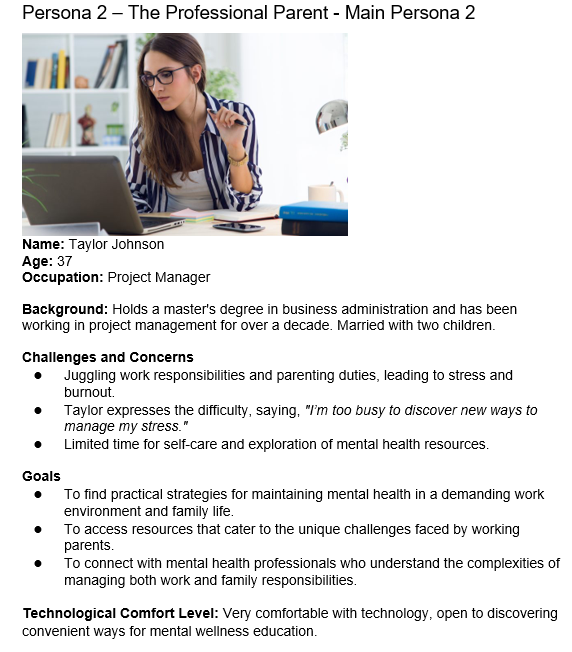
Created Taylor Johnson, one of the project's primary personas.
The broader group research considered young adults, working professionals, parents and caregivers, seniors, mental health professionals, and patients across age groups.
Persona Development
Taylor served as the primary focus of the individual scenario work that followed, creating continuity from persona development through interaction design.
Phase 3: Scenario Development
Developed increasingly detailed scenarios around Taylor's experience to translate broader user needs into specific interactions.
Problem Scenario
Created Taylor's written problem scenario and accompanying visual storyboard to establish the context and challenges surrounding the user's mental wellness needs.
Activity Scenario
Developed the written activity scenario and visual storyboard to explore how Mental Health Nest could support Taylor's goals.
Keypath Scenario
Created Taylor's keypath scenario to define the specific sequence of interactions required to accomplish a goal within the application.
Scenario Progression
Together, these artifacts demonstrate the progression from understanding a user's circumstances to defining the interactions needed within the product.
Phase 4: Interaction Design & Prototyping
Translated the scenario work into an interactive application experience.
Took the lead in developing the preliminary Mental Health Nest prototype in Figma.
Helped establish the initial design foundation used to develop additional persona experiences.
Created an additional keypath scenario and Figma prototype for Taylor.
Participated in task delegation and coordination as the group moved into prototype development.
Refined project materials and deliverables in response to course feedback.
Solution
An Integrated Mental Wellness Experience
The resulting group concept brought several forms of mental wellness support into one application.
Mood & Activity Tracking
Provides users with tools for consistently recording and reviewing mental wellness information.
Educational Resources
Offers access to media and information related to mental health and wellness.
Professional Support
Connects users with mental health professionals and supports virtual access to care.
Community Support
Provides opportunities to engage with support groups and other mental wellness resources.
Interactive Prototype
The final interactive prototype incorporated keypaths for multiple personas and demonstrated how different users could navigate Mental Health Nest according to their individual goals and circumstances.
Impact
Developed a group application concept addressing multiple aspects of mental wellness support within one experience.
Contributed to a claims analysis spanning 20 existing mental health applications.
Helped define target demographics representing users across different ages and circumstances.
Developed a complete persona-to-interaction progression for Taylor through persona, problem scenario, activity scenario, storyboard, and keypath work.
Led development of the preliminary Figma prototype used as a foundation for continued group design.
Contributed to the final interactive prototype and supporting project documentation.
The project demonstrated how broad research and user scenarios could progressively translate into concrete interaction paths and an interactive product concept.
Learnings
Broad problem spaces benefit from progressively narrowing research into specific users, scenarios, and interactions.
Personas become more useful when they directly inform subsequent scenario and design decisions.
Moving from problem scenarios to activity scenarios and then keypaths creates a clear progression from understanding a user's situation to designing specific interactions.
Competitive research can help evaluate both the benefits and limitations of existing approaches before incorporating similar concepts into a new product.
Collaborative design requires maintaining consistency across work created by multiple contributors while allowing individual user scenarios to inform different parts of the experience.
Tools & Methods
Figma · Claims Analysis · Competitive Research · Stakeholder Analysis · Target Demographics · Personas · Problem Scenarios · Activity Scenarios · Storyboarding · Keypath Scenarios · Interaction Design · Interactive Prototyping